




Introduction
Is sustainability the best we can do or is it time to move beyond sustainability and towards regeneration?
Here at Intego, we believe sustainability has its place, but the reality of what’s needed to transform our systems is more complex than that. Think about the cumulative damage we’ve done to the environment over the last decades.
Surely, we must agree it’s something that needs restoring and, ultimately, regenerating. There’s a lot of talk about net-zero impact. What’s missing from that view is the answer to the question: how do we counteract the damage already done? This is why we need to move beyond sustainability and towards regeneration.

But what is regeneration?
The concept of regeneration has been embedded in Indigenous Knowledge for millennia. It’s only over the last few years that it’s been slowly growing at the margins of Western societies (finally! 😉).
Regeneration refers to the process of reviving or restoring a system to a better condition. More than that, though, it’s about changing the system into something different and better that aligns with each place’s natural and cultural characteristics.
When working regeneratively, we aim to renew, restore, and revive a system so it can thrive into the future and continue to evolve on its own. Some of the positive outcomes of regeneration include: helping us build adaptive and resilient systems, enhancing our capabilities and contributing net positive benefits. Ultimately, it helps us build a healthier, thriving world.
The downside of regeneration is that it can be complex, abstract, and difficult to grasp. So, we’ve created this blog post to cut through the fluff, help simplify regenerative practices and provide guidance to move you beyond sustainability and towards regeneration.
Moving beyond sustainability and towards regeneration: what’s the need?
Sustainability has many shortcomings. We will cover these in a future blog post. Here, we focus on the three that stand out the most based on our research.

Reductionist, mechanistic, and anthropocentric thinking: This means simplistic, machine-like, human-centred thinking prevails, with humans having dominion over nature.
Historically, we’ve viewed nature in two different models. The first one sees us, humans, as separate from nature. The second one views us as part of nature. As practised today, sustainability still embraces that first model where everything is seen in parts and nature is viewed as a machine that exists to serve our needs.

Efficiency and mitigation: In sustainability, problems can be managed through tools, strategies, certifications, indicators and technology that drive efficiency and reduce harm. This means the main focus of sustainability is on ‘doing less harm’. Of course, the implication here is that damage is still occurring, but to a lesser extent.
Sustainability doesn’t stop to consider how we can restore what’s already been lost. It’s like slowing down the speed at which a train travels so that we can postpone the train wreck by one more month, one more year, or one more decade.
Neoliberalism: Free-market capitalism still dominates, with growth remaining a central pillar. Sustainability still promotes economic growth driven by consumerism that maximises profit. However, it promotes a cleaner way of growing the economy with the help of new technologies and approaches, such as cleaner production.
Regeneration vs sustainability: what’s the difference?
In the spirit of keeping things simple, we’ve summarised the difference between regeneration and sustainability in the table below.
We encourage you to refer to this table as you transition beyond sustainability and towards regeneration.
| Characteristic | Sustainability | Regeneration |
| Paradigm | Mechanistic worldview/industrial economic growth | Ecological worldview/regenerative paradigm |
| Potential | Generic technologies, universal solutions to problems | Place-based development for realising potential |
| Participation & Collaboration | Top-down, ‘expert-led’ approaches | Top-up, grassroots-led, inclusion of all stakeholders |
| Systems | The economic dimension is prioritised, and social, environmental and economic kept separate | Whole systems, social, cultural, economic, political, spiritual and ecological, are interrelated |
| Human-nature relationship | Humans are viewed as separate from nature, and competition between nature and humans | Humans and nature are interconnected and co-evolving, respects planetary boundaries, promote reciprocity |
| Purpose | Contribute to sustainable development, focus on minimising impact and doing less harm | Build the capacity of systems for net positive impact |
So, ultimately, we need to shift our current mechanistic mindset from minimising harm and prioritising technological efficiency to embracing an ecological worldview and building net-positive benefits that regenerate nature, communities and places.
Core Principles
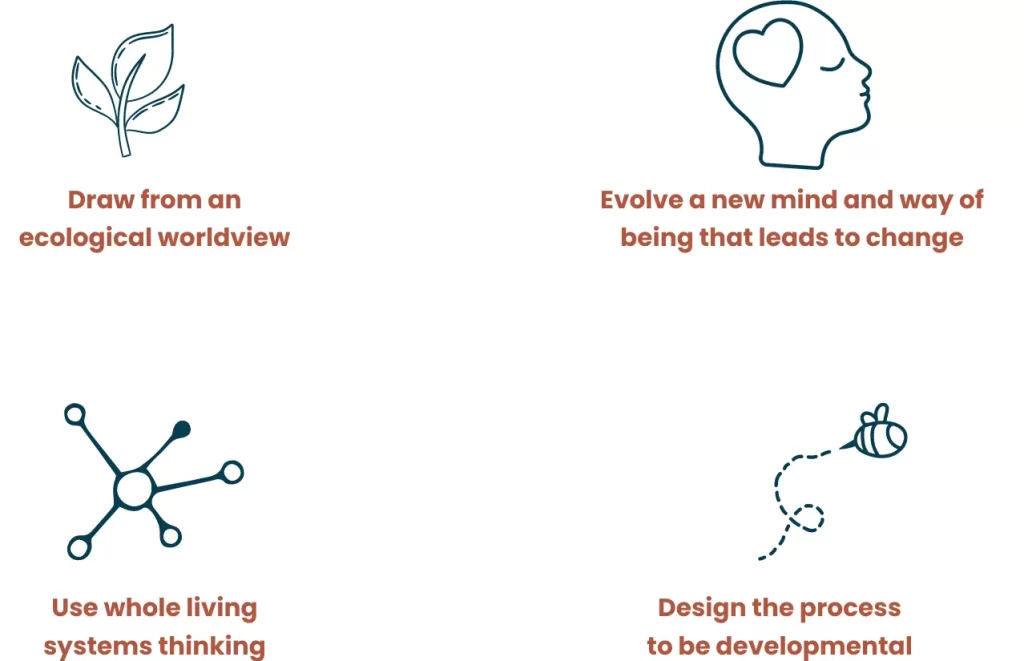
Principle 1: Draw from an ecological worldview
An ecological worldview is a way of thinking that emphasises the importance of nature and the interconnectedness of everything in the world. It recognises that humans are a part of nature and that our well-being depends on the health of the environment. Instead of seeing nature as something to be dominated or used only for our benefit, the ecological worldview values the balance and harmony of ecosystems.
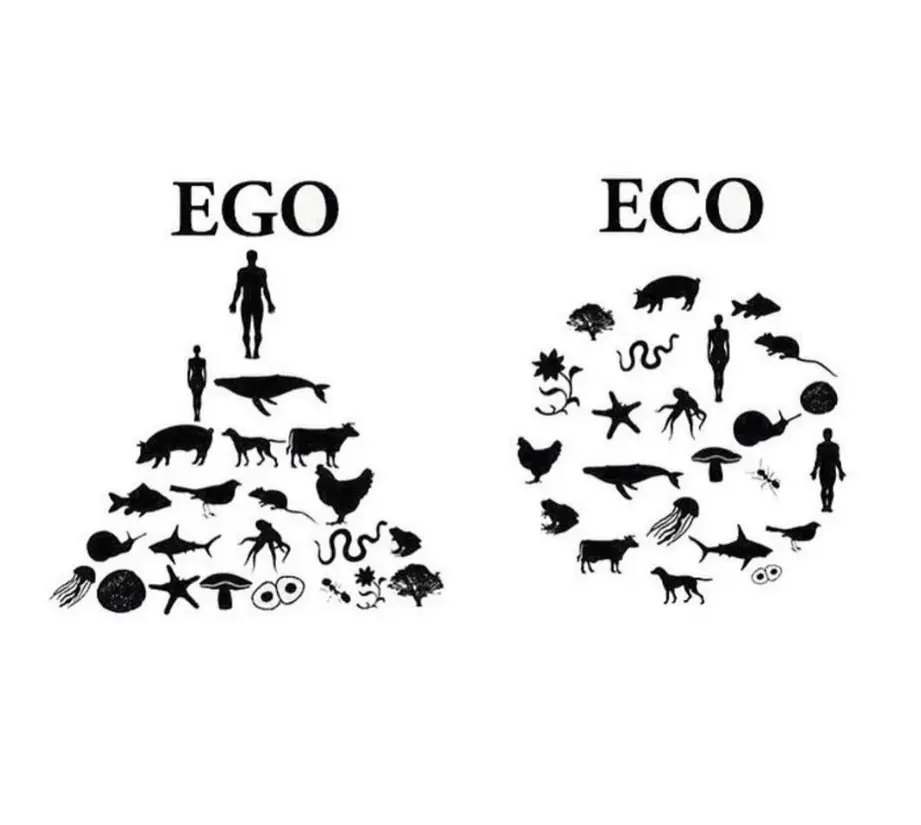
The ecological worldview also acknowledges Indigenous Knowledge systems. Indigenous knowledge refers to the wisdom, understanding, and practices indigenous cultures have developed over generations about their environment. It often emphasises the harmonious relationship between humans and nature, deeply respecting the Earth and its resources.
Principle 2: Use whole living systems thinking
First things first: a system is a set of things – people, cells, molecules, whatever – interconnected in such a way that they produce their own pattern of behaviour over time.
Whole living systems thinking is a way of looking at the world that considers everything as connected and part of a bigger picture. Instead of focusing on individual parts, it looks at the whole system, like seeing the entire forest instead of just the trees. This approach explores how a system’s parts are organised, how they interact, and how these relationships create specific behaviours.
As part of adopting whole living systems thinking, regeneration enables us to design for evolution, partner with place, and leverage systemic regeneration through targeted interventions.

What the heck does this mean?
Designing for evolution means recognising that humans can actively contribute to the growth and development of living systems. It’s like working together and evolving alongside nature. To do this, we need to align our actions with the wisdom of nature and establish a mutually beneficial relationship with her and other living systems.
Partnering with ‘place’ is about considering specific locations’ unique characteristics and true nature. This means using tailored approaches that perfectly suit each place. It is only through understanding the unique qualities and essence of place that regeneration begins.
Ultimately, we must learn to leverage systemic regeneration through targeted interventions.
Phew. This sounds complicated, doesn’t it? Let’s simplify it.
Imagine a lever. In regeneration, the idea of leverage works similarly to moving something heavy. Instead of using force, you find specific points or areas in a system where you can make changes that will positively impact the entire system, like creating a ripple effect in a body of water.

Principle 3: Evolve a new mind and way of being that leads to change
Evolving a new mind involves changing how we view things – a.k.a. a paradigm shift. A paradigm shift in regenerative development entails shifting our perspective from traditional development methods to an all-encompassing approach that prioritises sustainability, resilience, and the well-being of both people and the environment. It recognises the interconnectedness of social, economic, and ecological systems, aiming to restore and enhance ecosystems while promoting equity and long-term benefits for all.
To develop this new mindset, we need to discover our value-adding roles and become a systems actualiser. To achieve this, we must view ourselves as part of a larger, interconnected system where we co-evolve with nature. So, our new ‘value-adding role’ should be about benefiting from nature while nature also benefits from us.
In other words, we become ‘pollinators’ for change.

Finally, regeneration is based on the idea that to positively impact the world, we need to change ourselves from within, so that our personal growth can benefit the larger living systems to which we are connected and the vital role we play within them. This is referred to as “systems actualising.” By fully embracing our value-adding role, we also contribute to the growth and development of the systems in which we are a part.
Principle 4: Design the process to be developmental
Regenerative development is not a quick fix or a magical solution to global problems. Instead, it helps communities grow and develop new abilities to overcome existing challenges. It is an ongoing process that goes beyond individual projects. A regenerative project serves as a starting point, bringing together different stakeholders to collaborate and continue working together to improve the living systems in which they are a part.
To design developmentally, we must work from potential, not problems, call forth a collective vocation and actualise systems so they may thrive into the future.
Working from potential
When we design for regeneration, we begin by considering potential. We ask ourselves, what can this place become in the future? We focus on bridging the gap between its current state and what it can become if it were to realise its true purpose.
Collective vocation
A collective vocation is when a group of people work together towards a common goal. It allows individuals to find their own purpose within the group. In a regenerative project, a collective vocation brings the community together, motivating them to work towards sustainability in a way that suits their unique place.
Actualising systems
Regenerative development has a lasting impact on a place. It’s like being a gardener who plants seeds and nurtures them, creating a self-sustaining garden. We play a vital role in the environment, just as bees pollinate flowers. This cooperation between humans and nature is referred to as co-evolving mutualism in the regeneration literature. To make it happen, we need to collaborate and unlock the potential of our places.
Benefits of moving beyond sustainability and towards regeneration
- Adaptive systems: Regeneration contributes to building the adaptive capacity of people and places. This means we can learn to respond, adapt, and evolve with future changes, contributing to the resilience of our places.
- Enhancement: We use this term to describe how regeneration enhances the good things that already exist in our systems. It’s about maintaining and enhancing the health of both ecological and human systems, as well as the places they inhabit. It’s also about going beyond ‘sustaining’ to providing net positive benefits.
- A healthier world: Regeneration also helps us build a healthier world by contributing to social, economic, environmental, and spiritual well-being, improving connections to culture and nature, and fostering healthy relationships between people and their surroundings.
- Resilience: Regeneration improves resilience through diversity, adaptability, and collaboration. It enhances the capacity of systems to withstand and recover from disturbances while maintaining essential ecosystem services. By fostering positive feedback loops and interconnectedness, regeneration helps systems thrive in the face of uncertainty and change.
- Thriving and flourishing: Regenerative development fosters flourishing systems by reconnecting human and natural systems, promoting biodiversity and creating conditions for a healthy future. It facilitates continuous evolution, allowing systems to thrive and contribute to long-term well-being.
So, there you have it. By doing the work required to move from sustainability and towards regeneration, you can help bring about these beneficial changes.
Regeneration in practice: What’s required to go from sustainability towards regeneration?
Well, that’s a topic for a different blog post! We will cover this in Part 2 of this series, “Simplifying Regenerative Practices for Purpose-Driven Leaders: An Easy Guide to Regeneration.”
In the meantime, here’s a quick snapshot:
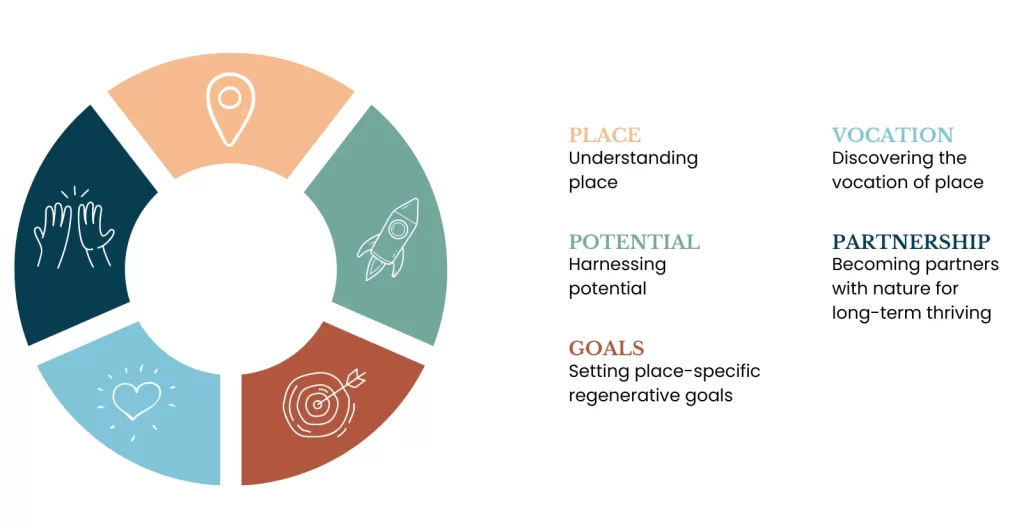
- Understanding place
- Harnessing potential
- Setting place-specific regenerative goals
- Discovering the vocation of place
- Becoming partners with nature for long-term thriving
Conclusion
To conclude, regeneration is the most effective way for us to transition from sustainability towards regeneration.
In this blog post, we summarise the shortcomings of sustainability, including its reductionist, mechanistic, and anthropocentric thinking, its focus on efficiency and mitigation, and the fact that it’s still embedded in a neoliberal discourse.
Using the principles of regeneration can help us shift our current mechanistic mindset from minimising harm and prioritising technological efficiency to embracing an ecological worldview and building net-positive benefits that regenerate nature, communities and places.

0 Comments